Wednesday, 14 September 2011

Taliesin's Revolt Against The Establishment

Even as a very small child Taliesin was able to inflict havoc on the dignity of Maelgwn Gwynedd’s Druidic Poetic company. Maelgwn Gwynedd was the King of Gwynedd (in Wales) who reigned from an unknown date until his death in c. 547. Mael Gwynedd is known more formally as Maelgwn ap Cadwallon (or in English, Maelgwn son of Cadwallon and also Maelgwn Hir Maelgwn the Tall).

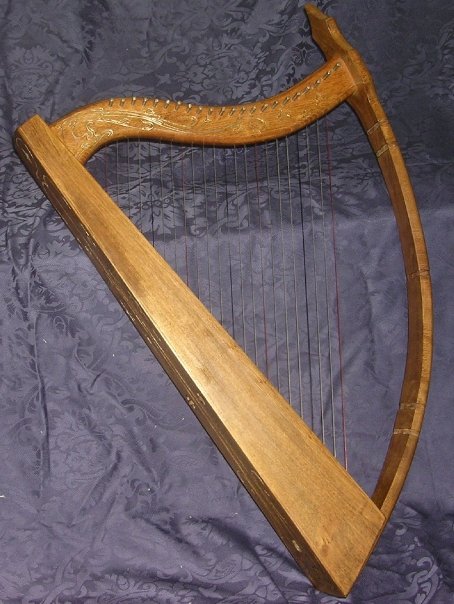
Although Taliesin was made an Ollamh and head of that particular Druidic Council or Society by his foster father Gwyddno Garanhir. He preferred to use the slightly lesser title of Anruth, the bearer of the Silver Bough, a branch of wood festooned with bells. When an Anruth approached and then entered a hall, all knew to respect the Anruth and to stop and listen - for the Anruth sang and spoke of poems and tales (usually accompanied by a simple harp for unending hours) of the great deeds of heros, Kings and Queens, of romance, mysticism, and all that the people considered enlightening, proper and entertaining for the age. (A possible example is attached at the ending of this blog. A Minster Lovell Harp which with the help of a friend and expert harp maker was made by myself and is completely handmade with carvings, silver gilt, silver inlay and all natural materials, whether purchased or made)

In Taliesin’s infancy (childhood) after his adoption by Gwyddno Garanhir, the Poetic Company of Maelgwn Gwynedd went to the king to demand their payment as was due. These 'Bards' passed Taliesin, who was sitting quietly in a corner. Taliesin played ‘blerwm, blerwm, blerwn’ on his lips with his finger. They looked upon the child and of course promptly ignored him.

These great Bards then stood before the King to demand their payment. They stood in unison to ask for their just demands, but the only utterance they could make was ‘blerwm, blerwm, blerwn’. Thus Taliesin made fools of them.

Amazed at the behaviour of such revered and highly regarded Bards and Anruths, Maelgwn Gwynedd demanded to know if they were indeed drunk! Despite their fury at this accusation, the Bards were forced to admit that it was due to the ‘power’ of the child Taliesin which caused them to act in such a way.

Thus we see Taliesin as not only an acclaimed bard and Anruth, but also as a Trickster with great wit even as a a mere child. It is also claimed that he was a shape shifter as shown in other stories regarding his life.

It is debated whether Taliesin was indeed a verified historical person or a myth. There are texts which are allegedly written by him. Traditionally his grave lies in Wales. Taliesin, the greatest of Welsh poets who  grew up and lived in the area around Llangynfelyn. It is thought that he returned to this area in his old age to die and is buried in the hills about Tre-Taliesin, the village which carries his name. There they claim his grave is still in this place and according to tradition is to be seen.

I believe that myths, folklore and tales have their roots in forgotten imaginations which are based partially on fact, archaeological evidence and history and perhaps what was believed was imbellished in order to explain that which was 'unexplainable' at the time, or simply to make it more interesting, enjoyable and/or to add impact to the stories/beliefs. But consider that that they may well bear a seed of truth. As with any myth or belief, for me at least, they are often inspirational and who knows?
;)

Thursday, 25 August 2011

International Musings


It is so rewarding to conceive that since our beginnings in 2010 we have become internationally respected designers. Our rune pendants and carved stone runesets have found homes as far as Mauritius, Canada, the U.S., England and Shetland (Scotland). The feedback we have received from our customers has been phenomenal. The talented and illustrious internationally acclaimed author, Joanne Harris (author of Runemarks, Runelight, Chocolat – amongst other amazing books) endorses us and has included us as Runemakers to provide rune pendants in an international competition for her soon to be released novel Runelight (sequel to Runemarks).

We cannot thank our customers and friends enough for their support and comments/suggestions.

Initially we provided velour velvet bags for the runesets, however after the suggestion of a customer that perhaps more natural eco-friendly bags would be more complementary, we have recently changed our bags to wonderful, quality, natural jute bags. This seems to have gone over very well. We also include parchment inserts with the runesets which explain the history of the various systems, definitions of the runes’ meanings, an idea of  how runes can be cast, along with a prologue from ‘Odin’, ‘Sayings of the High One’ (Poetic Edda) which describes the secrets of runes and his knowledge of spells.

As always, our runic pendants are supplied with sterling silver findings and an adjustable leather cord, presented in a beautiful velvet box along with a small parchment insert describing the rune according to the rune system ordered (Elder/Younger Futhark).


On our site we have examples of individual original designs (Jormangund – World Serpent, Double Spiral Celtic Ring and Yggdrasil handmade cards). Although we do not list these in our shop, queries and quotes are available upon request. The Yggdrasil cards have already been commissioned and we hope that these cards, along with a ‘Glastonbury Thorn’ design will be listed on our site very soon. We also will be introducing a large selection of original photo cards. We are constantly experimenting and evolving new products and designs including ‘charm’ bracelets which again we hope to be listing very soon. We also hope to be working soon in bronze and have a beautiful ‘reproduction’ of a Viking grave artefact, Mjolnir (Thor’s Hammer) which we hope we can ‘cast’ soon. Of course we always welcome commissions and custom designs.


Although our rune designs are simple, they convey a tactile pendant/stone rune and are historically accurate. As each item we make is completely hand crafted, each design will vary and be a unique piece that only you will own. No one will have a piece that is identical to yours.

We are thrilled that our designs have touched people across the globe. We pride ourselves on our workmanship and quality, both in creating our designs and in our presentation which of course is included in the price.

We must say we were particularly pleased when we received an order from Shetland. These remote and ancient islands are strongly associated with the Norse and to have one of our pendants find a home there has made us very proud indeed!


Believe us when we say that what we create is not just something that we sell, it is something that we put our hearts and souls into and every time we post anything we offer, a bit of us goes with it.

Friday, 8 July 2011

The Silver Bough Forums

We are pleased to announce the launch of our new Forum (Or Message Board as some of you might prefer).
Come and register (for free) and discuss all things Norse and Celtic with like minded individuals.
You might even make some new friends along the way.

There's a Norse section, a Celtic section and even an off topic section where you can discuss whatever you like (within reason  ;) )

So come and join up today

The Silver Bough Forums


Monday, 4 July 2011

RUNELIGHT

Following on from the amazing adventures of Runemarks, Joanne Harris has given us another glimpse into her realm of Norse Gods, demons, goblins, fantastic creatures and her young heroine, Maddy Smith. Enter a domain of adventure, deception, strategy, love, tragedy and a dollop of humour; where things are rarely what they seem to be.
Welcome to the compelling world of RUNELIGHT. Coming this Autumn to a book seller near you.


Tuesday, 28 June 2011

Odin - Part 1

'Then Gangleri asked, “Which Æsir ought men to believe in?”

'High answered, “There are twelve Æsir whose nature is divine.”

'Just-as-High added: “The goddesses are no less sacred, nor are they less powerful”

'The Third said, “Odin is the highest and oldest of the gods. He rules in all matters and although the other gods are powerful, all serve him as children do their father. Frigg is his wife. She knows the fates of mankind, even though she refuses to pronounce prophecies. So it is said here. Odin spoke with one of the Æsir, Loki.

'“You are raving, Loki,

and out of your mind,

why, Loki, do you not stop?

Frigg knows,

I believe the fate of all,

though she herself says nothing.”

(Loki’s flyting)’


Odin is called All-Father. He is the 'oldest' (though he was sired by Bor?), father of all the gods. He is called Father of the slain. All that fall in battle are his adopted sons. With the fallen he mans Valhalla and Vingolf. They are known as the Einherjar. Odin is also named Hang-God (god of the hanged), Hapta-God (god of the prisoners) and Farma-God (God of cargoes). Odin’s names are many.

Grim
Gangleri
Herjan, Hjalmberi,
Thekk, Thrid,
Thunn, Unn,
Helblindi, Har
Sann Svipal,
Sanngetal,
Herteit, Hnikar,
Bileyg, Baleyg,
Boverk, Fjolnir,
Grimnir, Glapsvid, Fjolsvid,
Sidhott, Sidskegg,
Sig-Father, Hnikud,
All-Father, Atrid, Farmatyr,
Oski, Omi,
Jafnhar, Blindi,
Gondlir, Harbard,
Svidur, Svidrir,
Jalk, Kjalar, Vidur,
Thror, Ygg, Thund,
Vak, Skilfing,
Vafud, Hroptatyr,
Gaut, Veratyr.
(The lay of Grimnir)

Do you wish to know more? These are the names. There are many.

The names were given as with all the languages of the world each name applies to the different tongues… to whom they might worship, to whom they might pray. Some names are derived from events that took place during Odin’s travels. Through these travels, evolve tales.

His wife Frigg is eventually banished due to an accusation of her infidelities, and yet Odin is certainly not beyond infidelity. His son is Thor whom we find Odin takes pleasure in deceiving and taunting. His blood brother Loki perhaps rebels against the ‘supreme’ fatherhood of Odin. Loki sees himself as Odin’s closest kin, equal of intellect but restrained.

Odin maintains his stance as the All-Father, Father of All, but Odin is not always honest, nor is his judgment always just. Plausibly through this, in the end, comes his ruin.

Odin is the All Father. And yet does he occasionally breach the line between masculinity and femininity? This accusation is submitted in the Lokasenna by Loki who makes his indictment. Odin is accused by Loki of practising Said on Samsey (‘beat on drums as witches do’). Loki can be father and mother and does not seem to feel it necessary to dispute his own masculine or feminine aspects. He, unlike Odin and the other gods, feels no need to deny what and who he is, nor deny his actions. He does, however, seem to crave the respect and acceptance of Odin and the other Æsir and Vanir, though in the climate of his standing with the other ‘gods’, he inevitably fails. Odin’s side is firmly as the ‘General’ with the Vanir and Æsir as necessary allies. Thus in his way Odin betrays his brother. The final result is Loki's 'betrayal' at Ragnarok leading to the end of the gods and the world.

In the ‘Sayings of the High One’ Odin contradicts himself by praising women, then warning the reader and criticising them as deceitful. His reflections are coloured by the advantages/disadvantages that women afford him in a given situation. However, within the ‘Sayings’ are relevant words (even today) from the All-Father and good and useful wisdom. Through his thoughts, one sees Odin’s fallibility, his ‘human’ nature, his insecurities, perhaps. Does this not bring this ‘god’, this All-Father nearer to mankind than many ‘supreme’ beings?


Friday, 17 June 2011

The Creatures Who Dwell in The Ash Tree Yggdrasil

There is an eagle who sits in the branches of Yggdrasil. It has the knowledge of many things. A hawk called Vedrfolnir (Wind Bleached) sits between its eyes. Ratatosk (Drill Tooth) is the squirrel who runs up and down the mighty ash. His words are of slanderous gossip and provokes the eagle and Nidhogg (the Wyrm). And many a god who has been annoyed by him. Dain, Dvalin, Duneyr and Durathror the four stags wander about in the branches of the ash and devour the tree’s foliage. There are more serpents under the ash than can be counted. Those Norns who live beside the Well of Urd draw water every day from the stream and splash this, mixed with the mud beside the Well over Yggdrasil so that it does not wither and decay. The water is so sacred that all things that come into contact with the spring become white and this is called ‘skin’ likened to the membrane on the inside of an eggshell.

I know an ash,
It is called Yggdrasil,
A high, holy tree,
Splashed and coated with white clay.
From it come the dew
That fall in the valleys.
It will always stand green over Urd’s Well.
(The Sibyl’s Prophecy)

The dew which falls to earth is called by people, honey dew and the bees feed on this. Two birds drink of the Well of Urd. They are swans.


Thursday, 16 June 2011

A Word On Loki

He, who is the trickster, the traitor, the most intelligent aside from Odin. He who taunts with a serpents tongue which is silvered by his words and brings ire to the others of  the Vanir and Aesir. He who shifts shape from salmon, to hawk, to woman, to mare. He who is most beautiful and gives the gods, despite their mistreatment and spite, what the gods want and need. He who takes wives of other men into his bed and fathers their children or possibly cuts off their hair. He who devises the demise of  Baldr.

Who is he?


Here I think we find a parallel between times, and perhaps of racism, or the excuse of 'racism'. Loki is of the Jotun, the race of giants (it appears in some translations that only his father was considered of the giant race, which thereby signifies that he is considered of the same. As opposed to those whose mothers were giants). However the irony here is that ALL the Aesir were derived from the ‘giant’ race. This does not concur with our modern idea of ‘giants’ as being very large beings. According to the Eddas the giants were the first amongst ‘manlike’ beings of the worlds. However the Aesir consider themselves as ‘different’, as superior and therefore divorce themselves from the race of the frost or fire giants. Loki is still considered a part of the original race, although, as stated, beautiful and more intelligent. He still holds giants’ blood in his veins and as all giants are considered evil and cruel, thus is Loki labelled.

Although Loki is taken in by Odin as his blood brother…this in some translations is done by slitting their wrists and pressing the individual wrists together and therefore binding, he is despised by the other ‘gods’ as being an outsider and one of the enemy. I would compare this with certain modern cultures looking at other cultures and their ways and views as being ‘evil’. And I think this was simply one of many excuses to dislike Loki and his ways.

Loki works with his intelligence and wits to do the gods’ bidding. As he is Odin’s ‘brother’, he should be respected and considered as one of the highest of the ‘Aesir’. He is not. He is asked for advice and when the advice does not suit the gods he is bullied, threatened and tortured. Yet he still continues to work with the gods in his unorthodox ways, thus the gods attain the power and goals they crave. If it weren’t for Loki there would be no Bifrost, there would be no Asgard, the power of the gods would be diminished. And still he is treated as a dog that should be kennelled or as a slave and miscreant in many ways.

Loki’s intelligence and cunning is only matched by Odin’s. This is probably the reason why Odin has taken him in. Odin recognised this. And I imagine that Loki’s intelligence and beauty was a matter of seduction (read this how you will) between Odin and Loki. Neither were ‘saints’ and both were prone to straddling the line between masculinity and femininity.

Again in my opinion, I think that there was a mutual need and attraction between Loki and Odin. Perhaps as different in his ‘race’ Loki wanted out of the Jotun culture and Odin recognising Loki’s gifts and appreciation of his ‘talents’ wanted Loki as an ally.

When we read of Loki, he is usually viewed by readers to be evil. He was simply a product of his environment and of himself. The ‘imprisonment’ of Loki prior to Ragnorak was an unjust and extremely cruel and barbaric act. His two sons by Sigyn were murdered. One was changed into a wolf which tore apart the other. The second’s intestines were used to create the chains that bound Loki to the rock, whereby a serpent (reflection of his son/daughter Jormangund) was suspended above him. His wife caught the venom dripping onto Loki’s face (causing extreme agony and thus as is Loki’s nature, earthquakes). But every time she emptied this bowl he faced more venom and agony. Now a time for reflection. What kind of an idiot was Sigyn? Two bowls…empty one, use the other for collection…of course without being too hard on Sigyn, there is the element of necessary breaks.


Then one thinks WHY did Loki marry Sigyn? Sigyn, the epitome of virtue, ever loyal and loving? Perhaps to gain acceptance? To mimic Odin in his marriage to Frigg? Loki’s famous liaison with Angrboda makes one ponder…three unusual demon children with a demon mother… He moves on to a compassionate if not particularly clever woman. I think it is clear. There is little said of Loki’s first ‘wife’ and his daughters. But one must assume from the bit of information we have, his first wife was not the usual, nor were his daughters.

Loki perhaps wanted the same love, affection and respect that the other gods received. Baldr the Beautiful was loved by all (except Loki). Baldr wasn’t the swiftest of thinkers and none of his decisions are ever effective, though considered wise (perhaps a label due to the love he garnered?). His demise was caused by Loki shifting his shape to a woman (a hag?) and thereby gaining this secret information from Frigg, Baldr’s mother. (Again think…Frig the Seeress couldn’t see beyond Loki’s disguise and divulged crucial information to a complete stranger? Doesn’t make sense.)
There you have Loki who is beautiful and a swift thinker and despised by family and all others. After constant abuse can you see now why someone with a heritage such as Loki’s, his upbringing, his sincere desires and efforts, would corrupt him further? I think we can understand this. The submissive would accept this and acquiesce. The strong willed and fiery will eventually rebel. Thus Loki does at Ragnorak after his escape from imprisonment and it is never clear HOW he escaped.

Loki tries to please. He goes to great lengths to please. His dark humour and willingness to jeopardise his own ‘person’ often lights up these stories.
His ordeal with the goat, tying the animal to his testicles in a 'tug of war' in order to make Skadi laugh is an example. His duping Thor to pose as Freya after a promised betrothal to the giant Thrym shows his humour and wits.
Still in the end he is suppressed and called a fool and a traitor. Can we blame him? I certainly can’t.